using MortalityTables
using Turing
using DataFramesMeta
using LinearAlgebra
using CairoMakie
using StatsBase31 Bayesian Mortality Modeling
“After a year of intense mental struggle, however, [Arthur Bailey] realized to his consternation that actuarial sledgehammering worked. He even preferred [the Bayesian underpinnings of credibility theory] to the elegance of frequentism. He positively liked formulae that described ‘actual data. . . . I realized that the hard-shelled underwriters were recognizing certain facts of life neglected by the statistical theorists.’ He wanted to give more weight to a large volume of data than to the frequentists’ small sample; doing so felt surprisingly ‘logical and reasonable.’ He concluded that only a ‘suicidal’ actuary would use Fisher’s method of maximum likelihood, which assigned a zero probability to nonevents.” - Sharon Bertsch McGrayne, Excerpt From The Theory That Would Not Die
31.1 Chapter Overview
An example of using a Bayesian MCMC approach with Turing.jl to fit a mortality curve to sample data, with multi-level models and censored data.
31.2 Generating fake data
The problem of interest is to look at mortality rates, which are given in terms of exposures (whether or not a life experienced a death in a given year).
We’ll grab some example rates from an insurance table, which has a “selection” component: When someone enters observation, say at age 50, their mortality is path dependent (so someone who started being observed at 50 will have a different risk/mortality rate at age 55 than someone who started being observed at 45). For simplicity, though, the simulation below uses the table’s ultimate rates only, so the generated data will not exhibit this selection effect.
Additionally, there may be additional groups of interest, such as:
- high/medium/low risk classification
- sex
- group (e.g. company, data source, etc.)
- type of insurance product offered
The example data will start with only the risk classification above.
n = 10_000
inforce = [(issue_age=rand(30:70), risk_level=rand(1:3)) for _ in 1:n]
10000-element Vector{@NamedTuple{issue_age::Int64, risk_level::Int64}}:
(issue_age = 43, risk_level = 1)
(issue_age = 67, risk_level = 3)
(issue_age = 30, risk_level = 1)
(issue_age = 68, risk_level = 3)
(issue_age = 35, risk_level = 1)
(issue_age = 63, risk_level = 1)
(issue_age = 46, risk_level = 3)
(issue_age = 51, risk_level = 2)
(issue_age = 52, risk_level = 3)
(issue_age = 66, risk_level = 2)
(issue_age = 58, risk_level = 1)
(issue_age = 63, risk_level = 3)
(issue_age = 43, risk_level = 1)
⋮
(issue_age = 69, risk_level = 1)
(issue_age = 38, risk_level = 1)
(issue_age = 30, risk_level = 2)
(issue_age = 48, risk_level = 3)
(issue_age = 57, risk_level = 1)
(issue_age = 60, risk_level = 1)
(issue_age = 38, risk_level = 1)
(issue_age = 68, risk_level = 3)
(issue_age = 59, risk_level = 3)
(issue_age = 32, risk_level = 3)
(issue_age = 37, risk_level = 1)
(issue_age = 32, risk_level = 2)tbl_name = "2001 VBT Residual Standard Select and Ultimate - Male Nonsmoker, ANB"
base_table = MortalityTables.table(tbl_name)
# Risk level multipliers: 1 = preferred (0.7x), 2 = standard (1.0x), 3 = substandard (1.5x)
const RISK_MULTIPLIERS = (0.7, 1.0, 1.5)
function tabular_mortality(params, issue_age, att_age, risk_level)
params.ultimate[att_age] * RISK_MULTIPLIERS[risk_level]
endtabular_mortality (generic function with 1 method)"""
Simulate mortality outcomes for a portfolio of policies.
Returns a DataFrame with one row per policy-year exposure.
"""
function model_outcomes(inforce, assumption, assumption_params; n_years=5)
# Pre-allocate result vectors
result_issue_age = Int[]
result_risk_level = Int[]
result_att_age = Int[]
result_death = Int[]
sizehint!(result_issue_age, length(inforce) * n_years)
sizehint!(result_risk_level, length(inforce) * n_years)
sizehint!(result_att_age, length(inforce) * n_years)
sizehint!(result_death, length(inforce) * n_years)
for pol in inforce
for t in 1:n_years
att_age = pol.issue_age + t - 1
q = assumption(assumption_params, pol.issue_age, att_age, pol.risk_level)
died = rand() < q
push!(result_issue_age, pol.issue_age)
push!(result_risk_level, pol.risk_level)
push!(result_att_age, att_age)
push!(result_death, died ? 1 : 0)
# If died, no more exposures for this policy
died && break
end
end
DataFrame(
issue_age=result_issue_age,
risk_level=result_risk_level,
att_age=result_att_age,
death=result_death,
exposures=ones(Int, length(result_death)) # each row is one exposure
)
end
exposures = model_outcomes(inforce, tabular_mortality, base_table)
# Aggregate by issue_age and att_age
data = @chain exposures begin
groupby([:issue_age, :att_age])
@combine(:exposures = length(:death),
:deaths = sum(:death),
:fraction = sum(:death) / length(:death))
end
# Aggregate including risk_level for multi-level modeling
data2 = @chain exposures begin
groupby([:issue_age, :att_age, :risk_level])
@combine(:exposures = length(:death),
:deaths = sum(:death),
:fraction = sum(:death) / length(:death))
end615×6 DataFrame
590 rows omitted
| Row | issue_age | att_age | risk_level | exposures | deaths | fraction |
|---|---|---|---|---|---|---|
| Int64 | Int64 | Int64 | Int64 | Int64 | Float64 | |
| 1 | 30 | 30 | 1 | 77 | 0 | 0.0 |
| 2 | 30 | 30 | 2 | 74 | 0 | 0.0 |
| 3 | 30 | 30 | 3 | 80 | 0 | 0.0 |
| 4 | 30 | 31 | 1 | 77 | 0 | 0.0 |
| 5 | 30 | 31 | 2 | 74 | 0 | 0.0 |
| 6 | 30 | 31 | 3 | 80 | 0 | 0.0 |
| 7 | 30 | 32 | 1 | 77 | 0 | 0.0 |
| 8 | 30 | 32 | 2 | 74 | 0 | 0.0 |
| 9 | 30 | 32 | 3 | 80 | 0 | 0.0 |
| 10 | 30 | 33 | 1 | 77 | 0 | 0.0 |
| 11 | 30 | 33 | 2 | 74 | 0 | 0.0 |
| 12 | 30 | 33 | 3 | 80 | 0 | 0.0 |
| 13 | 30 | 34 | 1 | 77 | 0 | 0.0 |
| ⋮ | ⋮ | ⋮ | ⋮ | ⋮ | ⋮ | ⋮ |
| 604 | 70 | 71 | 1 | 88 | 1 | 0.0113636 |
| 605 | 70 | 71 | 2 | 76 | 3 | 0.0394737 |
| 606 | 70 | 71 | 3 | 81 | 2 | 0.0246914 |
| 607 | 70 | 72 | 1 | 87 | 4 | 0.045977 |
| 608 | 70 | 72 | 2 | 73 | 3 | 0.0410959 |
| 609 | 70 | 72 | 3 | 79 | 2 | 0.0253165 |
| 610 | 70 | 73 | 1 | 83 | 6 | 0.0722892 |
| 611 | 70 | 73 | 2 | 70 | 2 | 0.0285714 |
| 612 | 70 | 73 | 3 | 77 | 5 | 0.0649351 |
| 613 | 70 | 74 | 1 | 77 | 3 | 0.038961 |
| 614 | 70 | 74 | 2 | 68 | 1 | 0.0147059 |
| 615 | 70 | 74 | 3 | 72 | 2 | 0.0277778 |
31.3 1. A single binomial parameter model
Estimate \(q\), the average mortality rate, not accounting for any variation within the population/sample. Our model is defined as a Beta prior on \(q\) with a Binomial likelihood:
\[ \begin{aligned} q &\sim \text{Beta}(1,1) \\ \text{deaths} &\sim \text{Binomial}(n, q) \end{aligned} \]
@model function mortality(exposures, deaths)
    q ~ Beta(1, 1)
    # Observe the death count for each age group
    for i in eachindex(deaths)
        deaths[i] ~ Binomial(exposures[i], q)
    end
end

m1 = mortality(data.exposures, data.deaths)
DynamicPPL.Model{typeof(mortality), (:exposures, :deaths), (), (), Tuple{Vector{Int64}, Vector{Int64}}, Tuple{}, DynamicPPL.DefaultContext, false}(Main.mortality, (exposures = [231, 231, 231, 231, 231, 256, 256, 255, 255, 254 … 246, 241, 231, 223, 219, 253, 245, 239, 230, 217], deaths = [0, 0, 0, 0, 0, 0, 1, 0, 1, 0 … 5, 10, 8, 4, 8, 8, 6, 9, 13, 6]), NamedTuple(), DynamicPPL.DefaultContext())31.3.1 Sampling from the posterior
We use a No-U-Turn-Sampler (NUTS) technique to sample multiple chains at once:
num_chains = 4
chain = sample(m1, NUTS(), MCMCThreads(), 400, num_chains)╭─FlexiChain (400 iterations, 4 chains) ───────────────────────────────────────╮ │ ↓ iter = 201:600 │ │ → chain = 1:4 │ │ │ │ Parameters (1) ── AbstractPPL.VarName │ │ Float64 q │ │ │ │ Extras (14) │ │ Int64 n_steps, tree_depth │ │ Bool is_accept, numerical_error │ │ Float64 acceptance_rate, log_density, hamiltonian_energy, │ │ hamiltonian_energy_error, max_hamiltonian_energy_error, step_size, │ │ nom_step_size, logprior, loglikelihood, logjoint │ ╰──────────────────────────────────────────────────────────────────────────────╯
Here, we have asked for the outcomes to be modeled via a single parameter for the population. We see that the posterior distribution of \(q\) is very close to the overall population mortality rate:
# Posterior mean of q should be close to the pooled fraction
(posterior_mean_q=mean(chain[:q]), pooled_fraction=sum(data.deaths) / sum(data.exposures))
(posterior_mean_q = 0.007951668571004317, pooled_fraction = 0.007932321674916823)However, we can see that the sampling of possible posterior parameters doesn’t really fit the data very well since our model was so simplified. The lines represent the posterior binomial probability.
This is saying that for the observed data, if there really is just a single probability q that governs the true process that came up with the data, there’s a pretty narrow range of values it could possibly be:
let
    data_weight = sqrt.(data.exposures) / 2
    f = Figure()
    ax = Axis(f[1, 1],
        xlabel="age",
        ylabel="mortality rate",
        limits=(nothing, nothing, -0.01, 0.10),
        title="Single-parameter Bayesian Mortality"
    )
    scatter!(ax,
        data.att_age,
        data.fraction,
        markersize=data_weight,
        color=(:blue, 0.5),
        label="Experience data (size ~ exposure)")

    # Subsample posterior draws of q
    n_samples = 300
    q_posterior = sample(vec(chain[:q]), n_samples)

    # Draw horizontal lines for each posterior sample
    for q in q_posterior
        hlines!(ax, [q], color=(:grey, 0.1))
    end

    f
end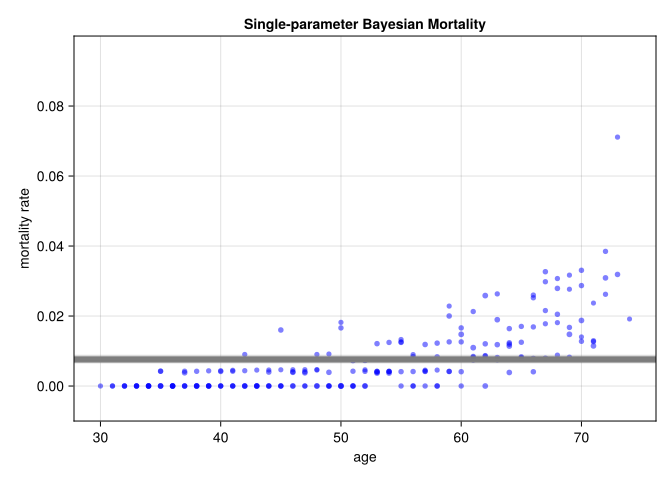
31.4 2. Parametric model
In this example, we utilize a MakehamBeard parameterization because it’s already very similar in form to a logistic function. This is important because our desired output is a probability (i.e., the probability of a death at a given age), so the value must be constrained to be in the interval between zero and one.
The prior distributions for a, b, and k are chosen to constrain the hazard (mortality) rate to be between zero and one (c is fixed at zero in this model; it becomes a sampled parameter in the final model below).
This isn’t an ideal parameterization (e.g. we aren’t including information about the select underwriting period), but is an example of utilizing Bayesian techniques on life experience data.
@model function mortality2(ages, exposures, deaths)
    a ~ Exponential(0.1)
    b ~ Exponential(0.1)
    c = 0.0
    k ~ truncated(Exponential(1), 1, Inf)

    # Create parametric mortality model once
    m = MortalityTables.MakehamBeard(; a, b, c, k)

    # Observe deaths for each age/exposure combination
    for i in eachindex(deaths)
        q = MortalityTables.hazard(m, ages[i])
        if !isfinite(q) || q < 0 || q > 1
            Turing.@addlogprob! -Inf
            return
        end
        deaths[i] ~ Binomial(exposures[i], q)
    end
end
mortality2 (generic function with 2 methods)
TipGuarding against invalid probabilities
During sampling, NUTS uses gradient-based proposals that can explore extreme parameter values. For example, a large b may cause exp(b * age) to overflow, producing a NaN hazard rate. Since Binomial(n, p) requires 0 ≤ p ≤ 1, passing an invalid value would throw a DomainError. The guard clause handles this by calling Turing.@addlogprob! -Inf, which sets the log-density to negative infinity and tells the sampler to reject that proposal. This is the idiomatic Turing.jl pattern for enforcing domain constraints that arise from complex likelihood computations.
We combine the model with the data and sample from the posterior using a similar call as before:
m2 = mortality2(data.att_age, data.exposures, data.deaths)

chain2 = sample(m2, NUTS(), MCMCThreads(), 400, num_chains)╭─FlexiChain (400 iterations, 4 chains) ───────────────────────────────────────╮ │ ↓ iter = 201:600 │ │ → chain = 1:4 │ │ │ │ Parameters (3) ── AbstractPPL.VarName │ │ Float64 a, b, k │ │ │ │ Extras (14) │ │ Int64 n_steps, tree_depth │ │ Bool is_accept, numerical_error │ │ Float64 acceptance_rate, log_density, hamiltonian_energy, │ │ hamiltonian_energy_error, max_hamiltonian_energy_error, step_size, │ │ nom_step_size, logprior, loglikelihood, logjoint │ ╰──────────────────────────────────────────────────────────────────────────────╯
31.4.1 Plotting samples from the posterior
We can see that the sampling of possible posterior parameters fits the data well:
let
    data_weight = sqrt.(data.exposures) / 2
    f = Figure()
    ax = Axis(f[1, 1],
        xlabel="age",
        ylabel="mortality rate",
        limits=(nothing, nothing, -0.01, 0.10),
        title="Parametric Bayesian Mortality"
    )
    scatter!(ax,
        data.att_age,
        data.fraction,
        markersize=data_weight,
        color=(:blue, 0.5),
        label="Experience data (size ~ exposure)")

    # Subsample joint posterior draws (a, b, and k taken from the same iteration)
    n_samples = 300
    idx = sample(1:length(vec(chain2[:a])), n_samples)
    a_samples = vec(chain2[:a])[idx]
    b_samples = vec(chain2[:b])[idx]
    k_samples = vec(chain2[:k])[idx]

    ages = sort!(unique(data.att_age))

    for i in 1:n_samples
        m = MortalityTables.MakehamBeard(; a=a_samples[i], b=b_samples[i], c=0.0, k=k_samples[i])
        qs = MortalityTables.hazard.(m, ages)
        lines!(ax, ages, qs, color=(:grey, 0.1))
    end
    f
end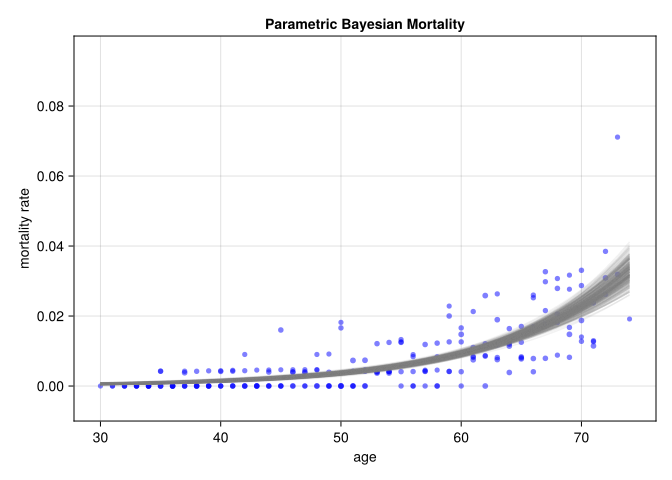
Recall that the lines are not plotting the possible outcomes of the claim rates, but the mean claim rate for the given age.
31.5 3. Multi-level model
This model extends the prior to create a multi-level model. Each risk class (risk_level) gets its own \(a\) parameter in the MakehamBeard model. The prior for \(a_i\) is determined by the hyper-parameter \(\bar{a}\).
@model function mortality3(ages, exposures, risk_levels, deaths, n_risk_levels)
    b ~ Exponential(0.1)
    ā ~ Exponential(0.1)
    a ~ filldist(Exponential(ā), n_risk_levels)
    c = 0.0
    k ~ truncated(Exponential(1), 1, Inf)

    # Observe deaths for each row
    for i in eachindex(deaths)
        m = MortalityTables.MakehamBeard(; a=a[risk_levels[i]], b, c, k)
        q = MortalityTables.hazard(m, ages[i])
        if !isfinite(q) || q < 0 || q > 1
            Turing.@addlogprob! -Inf
            return
        end
        deaths[i] ~ Binomial(exposures[i], q)
    end
end

n_risk_levels = length(unique(data2.risk_level))
m3 = mortality3(data2.att_age, data2.exposures, data2.risk_level, data2.deaths, n_risk_levels)

chain3 = sample(m3, NUTS(), 1000)

summarystats(chain3)╭─FlexiSummary (9 statistics) ─────────────────────────────────────────────────╮ │ iter collapsed │ │ chain collapsed │ │ ↓ stat = [mean, std, mcse, ess_bulk, ess_tail, rhat, q5, q50, q95] │ │ │ │ Parameters (6) ── AbstractPPL.VarName │ │ Float64 b, ā, a[1], a[2], a[3], k │ │ │ │ Extras (14) │ │ Float64 n_steps, is_accept, acceptance_rate, log_density, │ │ hamiltonian_energy, hamiltonian_energy_error, │ │ max_hamiltonian_energy_error, tree_depth, numerical_error, │ │ step_size, nom_step_size, logprior, loglikelihood, logjoint │ │ │ │ Summary │ │ param mean std mcse ess_bulk ess_tail rhat q5 … │ │ b 4.8239 0.0002 0.0001 3.7195 21.1839 1.6339 4.8236 … │ │ ā 0.7550 0.0000 0.0000 10.5756 20.3236 1.0798 0.7550 … │ │ a[1] 1.5925 0.0001 0.0000 2.5889 22.1047 2.0531 1.5924 … │ │ a[2] 2.4170 0.0001 0.0001 2.4599 13.3781 2.0539 2.4169 … │ │ a[3] 0.6748 0.0000 0.0000 2.6350 26.7112 1.9214 0.6748 … │ │ k 1.1493 0.0000 0.0000 6.4504 16.8189 1.0637 1.1493 … │ ╰──────────────────────────────────────────────────────────────────────────────╯
let
    colors = Makie.wong_colors()
    data_weight = sqrt.(data2.exposures)

    p, ax, _ = scatter(
        data2.att_age,
        data2.fraction,
        markersize=data_weight,
        alpha=0.5,
        color=[(colors[c], 0.7) for c in data2.risk_level],
        label="Experience data point",
        axis=(
            xlabel="age",
            limits=(nothing, nothing, -0.01, 0.10),
            ylabel="mortality rate",
            title="Multi-level Bayesian Mortality"
        )
    )

    # Subsample joint posterior draws (a, b, and k taken from the same iteration)
    n_samples = 100
    idx = sample(1:length(vec(chain3[:b])), n_samples)
    b_samples = vec(chain3[:b])[idx]
    k_samples = vec(chain3[:k])[idx]

    ages = sort!(unique(data2.att_age))

    for r in 1:3
        a_samples = vec(chain3[@varname(a[r])])[idx]
        for i in 1:n_samples
            m = MortalityTables.MakehamBeard(; a=a_samples[i], b=b_samples[i], c=0.0, k=k_samples[i])
            qs = MortalityTables.hazard.(m, ages)
            lines!(ages, qs, label="risk level $r", alpha=0.2, color=(colors[r], 0.2))
        end
    end
    axislegend(ax, merge=true)
    p
end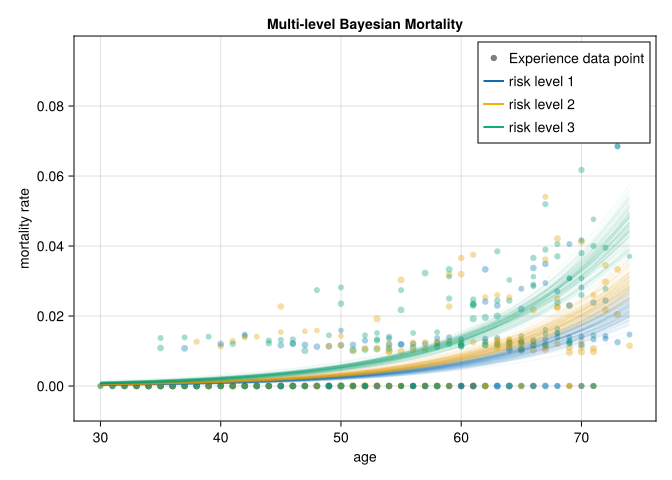
Again, the lines are not plotting the possible outcomes of the claim rates, but the mean claim rate for the given age and risk class.
31.6 Handling non-unit exposures
The key is to use the Poisson distribution, which is a limiting approximation to the Binomial distribution:
@model function mortality4(ages, exposures, risk_levels, deaths, n_risk_levels)
    b ~ Exponential(0.1)
    ā ~ Exponential(0.1)
    a ~ filldist(Exponential(ā), n_risk_levels)
    c ~ Beta(4, 18)
    k ~ truncated(Exponential(1), 1, Inf)

    # Observe deaths for each row using Poisson likelihood
    for i in eachindex(deaths)
        m = MortalityTables.MakehamBeard(; a=a[risk_levels[i]], b, c, k)
        q = MortalityTables.hazard(m, ages[i])
        if !isfinite(q) || q < 0 || q > 1
            Turing.@addlogprob! -Inf
            return
        end
        deaths[i] ~ Poisson(exposures[i] * q)
    end
end

m4 = mortality4(data2.att_age, data2.exposures, data2.risk_level, data2.deaths, n_risk_levels)

chain4 = sample(m4, NUTS(), 1000)╭─FlexiChain (1000 iterations, 1 chain) ───────────────────────────────────────╮ │ ↓ iter = 501:1500 │ │ → chain = 1:1 │ │ │ │ Parameters (5) ── AbstractPPL.VarName │ │ Float64 b, ā, c, k │ │ Vector{Float64} a (3,) │ │ │ │ Extras (14) │ │ Int64 n_steps, tree_depth │ │ Bool is_accept, numerical_error │ │ Float64 acceptance_rate, log_density, hamiltonian_energy, │ │ hamiltonian_energy_error, max_hamiltonian_energy_error, step_size, │ │ nom_step_size, logprior, loglikelihood, logjoint │ ╰──────────────────────────────────────────────────────────────────────────────╯
# Extract posterior means for risk factors and compute relative factors
risk_factors4 = [mean(chain4[@varname(a[f])]) for f in 1:3]
println("Risk factors relative to standard (level 2): ", risk_factors4 ./ risk_factors4[2])

let
    colors = Makie.wong_colors()
    data_weight = sqrt.(data2.exposures) / 2

    p, ax, _ = scatter(
        data2.att_age,
        data2.fraction,
        markersize=data_weight,
        alpha=0.5,
        color=data2.risk_level,
        label="Experience data point",
        axis=(
            xlabel="age",
            limits=(nothing, nothing, -0.01, 0.10),
            ylabel="mortality rate",
            title="Poisson Multi-level Bayesian Mortality"
        )
    )

    # Subsample joint posterior draws (a, b, c, and k taken from the same iteration)
    n_samples = 100
    idx = sample(1:length(vec(chain4[:b])), n_samples)
    b_samples = vec(chain4[:b])[idx]
    c_samples = vec(chain4[:c])[idx]
    k_samples = vec(chain4[:k])[idx]

    ages = sort!(unique(data2.att_age))

    for r in 1:3
        a_samples = vec(chain4[@varname(a[r])])[idx]
        for i in 1:n_samples
            m = MortalityTables.MakehamBeard(; a=a_samples[i], b=b_samples[i], c=c_samples[i], k=k_samples[i])
            qs = MortalityTables.hazard.(m, ages)
            lines!(ages, qs, label="risk level $r", alpha=0.2, color=(colors[r], 0.2))
        end
    end
    axislegend(ax, merge=true)
    p
end
Risk factors relative to standard (level 2): [0.8663552552791414, 1.0, 1.9008056839792784]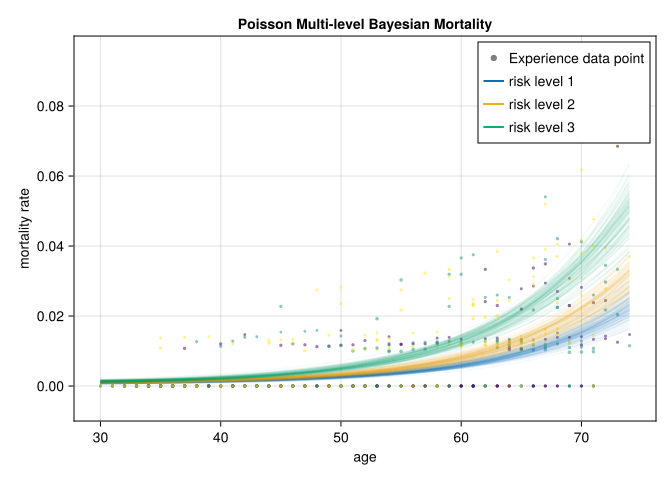
31.7 Model Predictions
We can generate predictive estimates by passing a vector of missing in place of the outcome variables and then calling predict.
We get a table of values where each row is the prediction implied by the corresponding chain sample, and the columns are the predicted value for each of the outcomes in our original dataset.
# Create model with missing deaths to generate predictions
pred_model = mortality4(
    data2.att_age,
    data2.exposures,
    data2.risk_level,
    fill(missing, length(data2.deaths)),
    n_risk_levels
)
preds = predict(pred_model, chain4; include_all=false);
Averaging the predictions across the chain samples gives the posterior-mean predicted deaths for each row of the data, which we can compare directly with the observed counts:
predicted_deaths = [mean(preds[@varname(deaths[i])]) for i in eachindex(data2.deaths)]
@transform(select(data2, :att_age, :risk_level, :exposures, :deaths),
    :predicted_deaths = round.(predicted_deaths; digits=1))
615×5 DataFrame
590 rows omitted
| Row | att_age | risk_level | exposures | deaths | predicted_deaths |
|---|---|---|---|---|---|
| Int64 | Int64 | Int64 | Int64 | Float64 | |
| 1 | 30 | 1 | 77 | 0 | 0.1 |
| 2 | 30 | 2 | 74 | 0 | 0.1 |
| 3 | 30 | 3 | 80 | 0 | 0.1 |
| 4 | 31 | 1 | 77 | 0 | 0.1 |
| 5 | 31 | 2 | 74 | 0 | 0.1 |
| 6 | 31 | 3 | 80 | 0 | 0.1 |
| 7 | 32 | 1 | 77 | 0 | 0.1 |
| 8 | 32 | 2 | 74 | 0 | 0.1 |
| 9 | 32 | 3 | 80 | 0 | 0.1 |
| 10 | 33 | 1 | 77 | 0 | 0.1 |
| 11 | 33 | 2 | 74 | 0 | 0.1 |
| 12 | 33 | 3 | 80 | 0 | 0.1 |
| 13 | 34 | 1 | 77 | 0 | 0.1 |
| ⋮ | ⋮ | ⋮ | ⋮ | ⋮ | ⋮ |
| 604 | 71 | 1 | 88 | 1 | 1.7 |
| 605 | 71 | 2 | 76 | 3 | 1.7 |
| 606 | 71 | 3 | 81 | 2 | 3.1 |
| 607 | 72 | 1 | 87 | 4 | 1.8 |
| 608 | 72 | 2 | 73 | 3 | 1.7 |
| 609 | 72 | 3 | 79 | 2 | 3.4 |
| 610 | 73 | 1 | 83 | 6 | 1.9 |
| 611 | 73 | 2 | 70 | 2 | 1.9 |
| 612 | 73 | 3 | 77 | 5 | 3.6 |
| 613 | 74 | 1 | 77 | 3 | 1.9 |
| 614 | 74 | 2 | 68 | 1 | 1.9 |
| 615 | 74 | 3 | 72 | 2 | 3.7 |
The posterior-mean predictions track the observed deaths closely across ages and risk levels — a compact posterior predictive check that the final multi-level model has captured the structure of the data.